Showing posts with label Soybeans. Show all posts

Thursday, November 5, 2020

United States Soybeans to Brazil

Many reports have shown that in May of 2020 Brazil overtook the United States as the number one soybean producing country in the world. With this being the case why is Brazil importing soybeans from the United States? The article linked below provides some answers. We encourage you to explore the linked article and utilize the discussion points to guide your conversations around the globe. 

Brazil-Bound U.S. Soybean Vessel Loading at Gulf Coast Terminal

Discussion Points

  • Why is Brazil turning to the United States for soybeans?
  • What did you find most surprising from the article and why?
  • Trade relations can have intended and unintended consequences that impact many around the globe. What are some examples within this article? 
  • What are the trade relations with your home country and the world? What do you see as the future?

Thursday, January 9, 2020

Soybeans Across Africa

Soybeans are a crop growing around the world with great potential over the continent of Africa. Linked below is a blog post from The Chicago Council on Global Affairs regarding soybean production and maximizing yields across Africa. We encourage you to read the linked post and utilize the discussion points provided to guide conversations around the globe.

Maximizing the Yield Potential of Soybean in Africa

Discussion Points

  • How has soybean production across the world and Africa changed in the past 30 years?
  • What is "input bundling" and why is it important?
  • What pests and challenges face soybean production across Africa? Do you find the same pests/challenges in your home region?
  • If you were the leader of an initiative to increase soybean production across Africa what initiatives and plans would you implement? How would you increase yields and production in Africa? What challenges might you face and how would you overcome them?

Friday, March 16, 2018

Agriculture and River Run

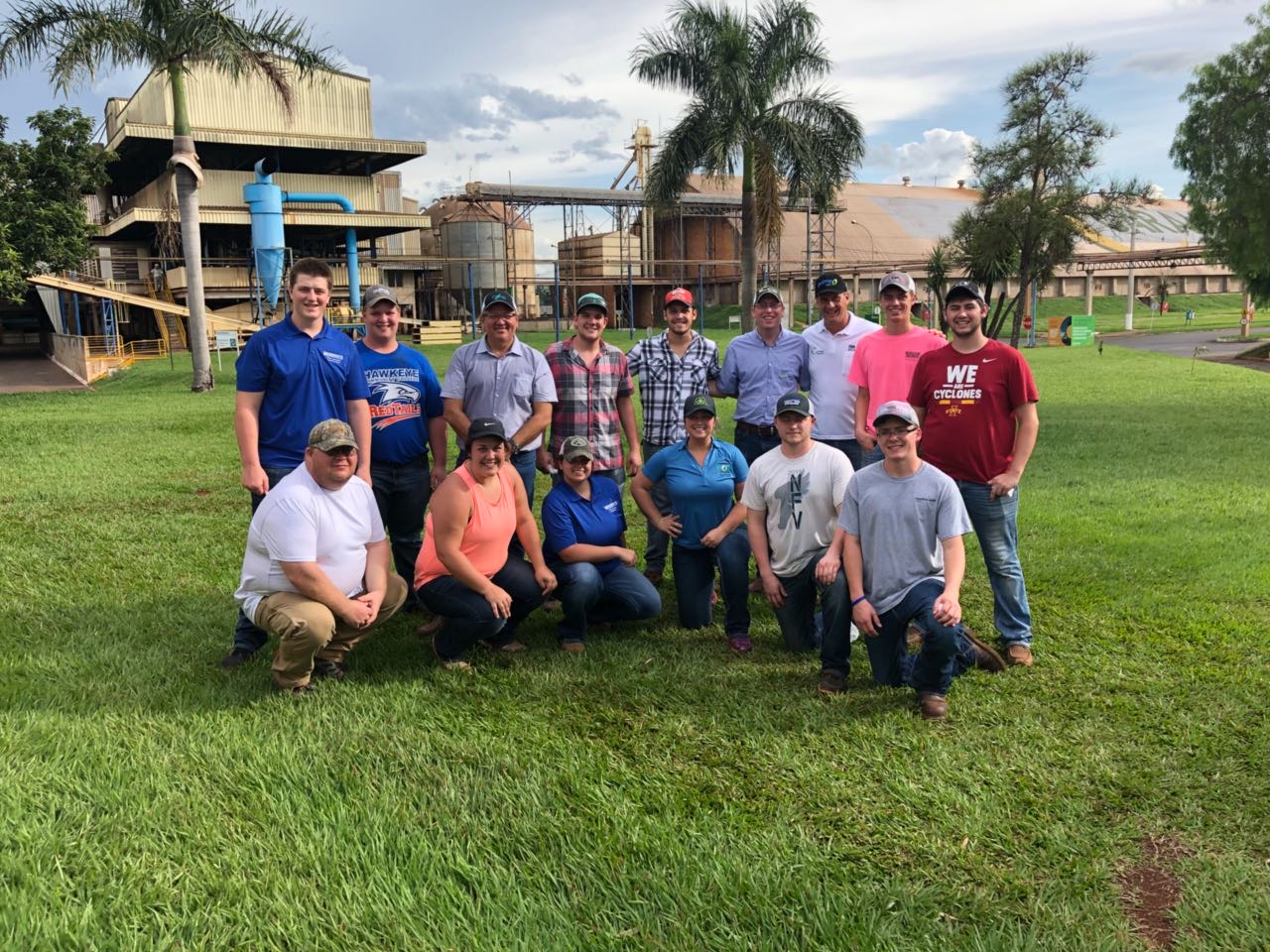
Today was our last full day in Brazil before we fly home tomorrow evening and return to Iowa on Sunday. We kicked off our day with a visit to a cotton processing facility. It is a family owned operation which grows and processes cotton so it can be shipped to clothing and material manufacturers in Brazil and around the world. We discussed the process from when it leaves the field to when it is shipped to manufacturers for production. After we learned about grading and all that goes into cotton production we made our way to the fields. We visited a cotton field that was planted in December and will be harvested in late May/early June. There was much discussion on production practices. Many were blown away be the intensive management of cotton which includes 26 passes of pesticides and 4 passes of fertilizers.

We enjoyed a traditional Brazilian lunch once again, which is a buffet style lunch with many options. Following lunch we visited Caramuru, a plant that processes soybeans and corn into many different products from corn meal to vegetable oil. The plant specializes in non-GMO soybean processing and sends a lot of that product to the Netherlands and Europe. The corn they work with is all GMO corn. They stated the premium for non-GMO soybeans is great and the reason for their procedures.


Following our hot day of touring we cooled off with boating and swimming in the river that separates the states of Goias and Minas Gerais. This was a relaxing way to end the day before enjoying a spectacular dinner with even better friends in Brazil! Tomorrow we will attend a field day in the morning before making our trek back home. There may not be another blog post until next week with two busy travel days ahead.

Wednesday, March 14, 2018

A Day of Dairy, Corn, and Soybeans

Today was a spectacular day of exploring agriculture in Brazil. We started off our day visiting the Piracanjuba dairy training center. Piracanjuba is a dairy company that produces and sells milk, cheese, and other dairy products. This center provides training for employees of dairy farms selling milk to Piracanjuba and also sends advisors out to farms to improve production. Students enjoyed comparing production practices in the USA to Brazil. One of the surprising challenges that Brazil is working to address is their high somatic cell count.

After lunch we visited a soybean and corn farm. The most common production practice is soybeans as a first crop followed by corn as a second crop. With irrigation they are starting to produce tomatoes, sweet corn, or edible beans as a third crop. This year they are going to follow the second crop with an African grass grazed with beef cattle in half of their fields. The grass helps reduce compaction in the fields. We were able to see harvest (soybeans) and planting (corn) within the same field in the same day. To end our time at the farm we visited second season corn crop that was 120 day maturity that was 7-8 feet tall after just 52 days of production.  It was an eye opening experience for all once again comparing production between our two countries.


We ended the evening at the hot springs pool at our hotel in Caldas Novas. We enjoyed an evening of conversation and reflection on the day at the pool and enjoyed dinner poolside. Unfortunately, our WiFi has not worked the best which is the reason for this late post. 

Thursday, October 26, 2017

South America's Crop Production

South America's impact on agriculture is evident. The linked article below provides an insight to crop production in South America and it's potential impact around the globe. We encourage you to read the linked article and utilize the discussion points below to guide your conversations in your local communities and classrooms.

South America Will Continue To Pressure Grain Prices

Discussion Points

  • What is the current outlook for crop production in South America?
  • How do you see this outlook impacting prices and production in your home country?
  • Besides the amount of crop being planted what other factors could affect global prices of corn and soybeans?
  • In your opinion what does the future for crop production hold for South America? Explain.
  • Explain how politics and policies can impact crop production and prices globaly?

Friday, March 17, 2017

Muito Quente

Mutio quente is a good description of today. Muito quente is Portuguese for "very hot." Today was in the mid 90's as we learned more about Brazilian agriculture. We started learning about cotton production. We were able to visit a cotton producer who works with Bayer Crop Science to produce cotton seed for future crops. He shared production practices, challenges, and some of the equipment used. Most of our group is familiar with corn and soybean production so a lot was learned.


From the farm we traveled to visit a cotton processing plant that is Japanese owned. They sell the cotton (60% exported, 40% domestic), keep seed for future crops, and then utilize the rest of the seeds for livestock feed. We were able to see the procedure of processing cotton including grading. The processing plant, also, had a large fruit and vegetable area so we were able to explore different fruits and vegetables produced in the region.

After lunch we traveled to Caramuru, a corn and soybean processing plant. We began with the corn plant where they were processing corn. A majority of the corn is processed into corn meal for cooking purposes and human consumption. The plant was "muito quente" with all the equipment running in the heat of the afternoon. Following our time in the corn processing area we made our way  to the oil extraction facility. They primarily produce soybean oil (90% of oil production), but also work with sunflower, canola, and corn oil. While there primary product is oil for cooking they use all parts of the crops in some way, shape, or form. Their packaging facility was impressive with all the robots. They are able to produce 700,000 liters of oil in one day.


Back home many of our students head to the river on a very hot day. In Brazil things are no different. One of the agribusiness that is hosting us in this area offered to meet us as the river to cool off. We enjoyed conversations while swimming and boating. Today concluded with dinner where we enjoyed great food and live Brazilian pop music. Tomorrow we make a long trek back to Brasilia before catching our flight back to the states tomorrow night.

Thursday, March 31, 2016

Soybeans: To Accept or Not

Featured below is an article from Ag Web that discusses the possibility of some elevators not accepting Roundup Ready 2 Xtend soybeans in the United States due to policies in place around the world with different countries. We encourage you to explore the linked article and startup conversations around the world in your classrooms and communities utilizing the provided discussion questions.

Elevators Say 'No Thanks' to Extend Soybeans

Discussion Points

  • Why are some elevators not accepting Roundup Ready 2 Xtend soybeans in the United States?
  • Why are many confident that in the future Roundup Ready 2 Xtend soybeans will be accepted by the EU?
  • How could the decision of the EU affect markets, supply, etc. in regards to accepting or not accepting Roundup Ready 2 Xtend soybeans? 
  • If you were a farmer and preparing for planting, would you plant Roundup Ready 2 Xtend soybeans or go with another option? Justify your response.